What you will learn The screens you meet after registering a system — slots, addresses and tags, and what is free versus paid. Work and cost live on Usage.
One system uses one slot.
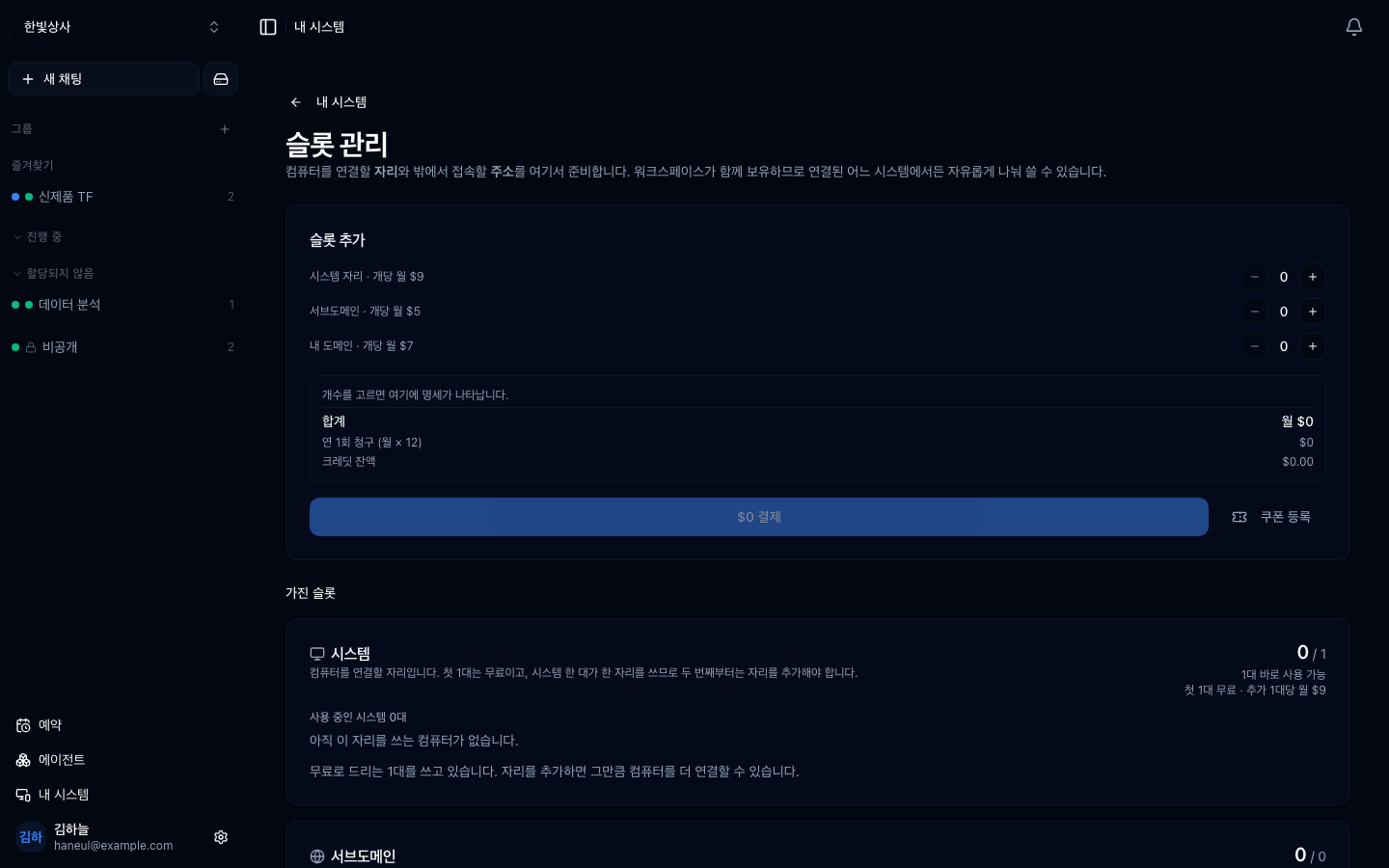
The first machine is free. From the second, you have to add a slot.
This structure matters because without a slot a system is pushed into waiting.
Nothing is lost while it waits. Records and settings remain, and adding a slot reconnects it immediately.
The address that reaches that machine from outside uses a slot too. There are two kinds.
| Kind | Meaning |
|---|---|
| Subdomain | an address provided so you can start immediately; created from the system in a few clicks |
| Your own domain | connect a domain you already own |
One slot backs one address. Subdomain slots and custom-domain slots are separate, so spare subdomain slots do not let you attach your own domain.
Covered in connecting a system, but easy to confuse on this screen.
| State | |
|---|---|
| Registering a system | free |
| Connecting the first machine | free |
| Handing work to a registered machine | free |
| Viewing progress and usage | free |
| From the second machine | add a slot (paid) |
| External addresses (tunnel) | slots (paid) |
Air-gapped (on-prem) installs have neither slots nor public addresses. The screen does not appear at all — an outbound channel breaks the premise of an air-gapped setup.
With several systems, group them with tags.
Tagging lets you hand work to "one of the machines tagged build." You do not have to name a specific machine.
Tag by role. Not by location or specification, but by what kind of work the machine can take.
Work sent to your registered machines collects under Usage (bottom of the sidebar). Pick a period and you see how it ended (done, stopped, error), who asked for it, and which machine spent what — all on one screen.
What stays here is one question: are my machines connected? Connection state, uptime, sessions left for dead, and slots. If two screens counted the same thing, their periods would drift apart one day — and after that nobody trusts either number.
Usage is tallied per machine. If workspace usage answers "what was it spent on," this answers "which machine spent it."
The second bears directly on cost. An unused machine holding a slot costs money.
1. What happens to a registered system when slots run out?
It is pushed into waiting. Records and settings remain intact, so adding a slot reconnects it immediately.
2. Can spare subdomain slots be used for your own domain?
No. Subdomain slots and custom-domain slots are separate; attaching your own domain requires that kind of slot.
3. What should tags be based on?
Role. Not location or specification, but what kind of work the machine can take — that is what makes "one of the machines tagged build" work without naming one.
Next, stacking requests to run in order → Scheduled — stack it up, hand it to the clock
1 slot · 2 systems registered→ 1 connected, 1 "waiting for a slot"2 subdomain slots · 1 in use → you can create one more0 custom domain slots → you cannot attach your own domain (add a slot)build-server-1 [build]build-server-2 [build]dev-pc-kim [dev]□ is it concentrated on one machine → can tags spread it□ is a system long unused → can you free its slot□ are all registered systems actually in use□ is any system waiting for a slot (that means it is being neglected)□ is an address attached but unused□ do the tags match the actual roles HyperTeams